A. AL-QAHTANI, F. AL-WARTHAN and A. KHANI, Saudi Aramco, Dhahran, Saudi Arabia
The methane (CH₄) pyrolysis process [also known as CH₄ cracking or turquoise hydrogen (H₂) production] is a thermal (high-temperature) breakdown of CH₄ into H₂ gas and solid carbon. The process typically takes place above 800°C in the absence of oxygen. The main products of the CH₄ pyrolysis process are H₂ and solid carbon, commonly known as carbon black, graphite and graphene. The process of CH₄ pyrolysis is as follows:
- CH₄ feed: CH₄ gas is fed into a reactor or furnace and heated to high temperatures without oxygen. This thermal energy breaks the strong bonds between the carbon and H₂ atoms in CH₄ molecules.
- Pyrolysis reaction: The thermal decomposition of CH₄ forms H₂ gas and solid carbon. The reaction can be represented as follows (Eq:1):
CH₄ –> C + 2H₂ (1)
2CH₄ –> C₂H₂ + 3H₂
- H₂ production: The H₂ produced from CH₄ pyrolysis can be used as a clean and versatile energy source. H₂ is a valuable fuel that can be utilized in various applications, including fuel cells for electricity generation, industrial processes and transportation.
- Solid carbon generation: The solid carbon (carbon black, graphite and graphene) generated during the CH₄ pyrolysis process has several potential uses. It can be utilized as a reinforcing agent in rubber and plastics, as a pigment in inks and coatings, or as a precursor for various carbon- based materials (Figure 1).
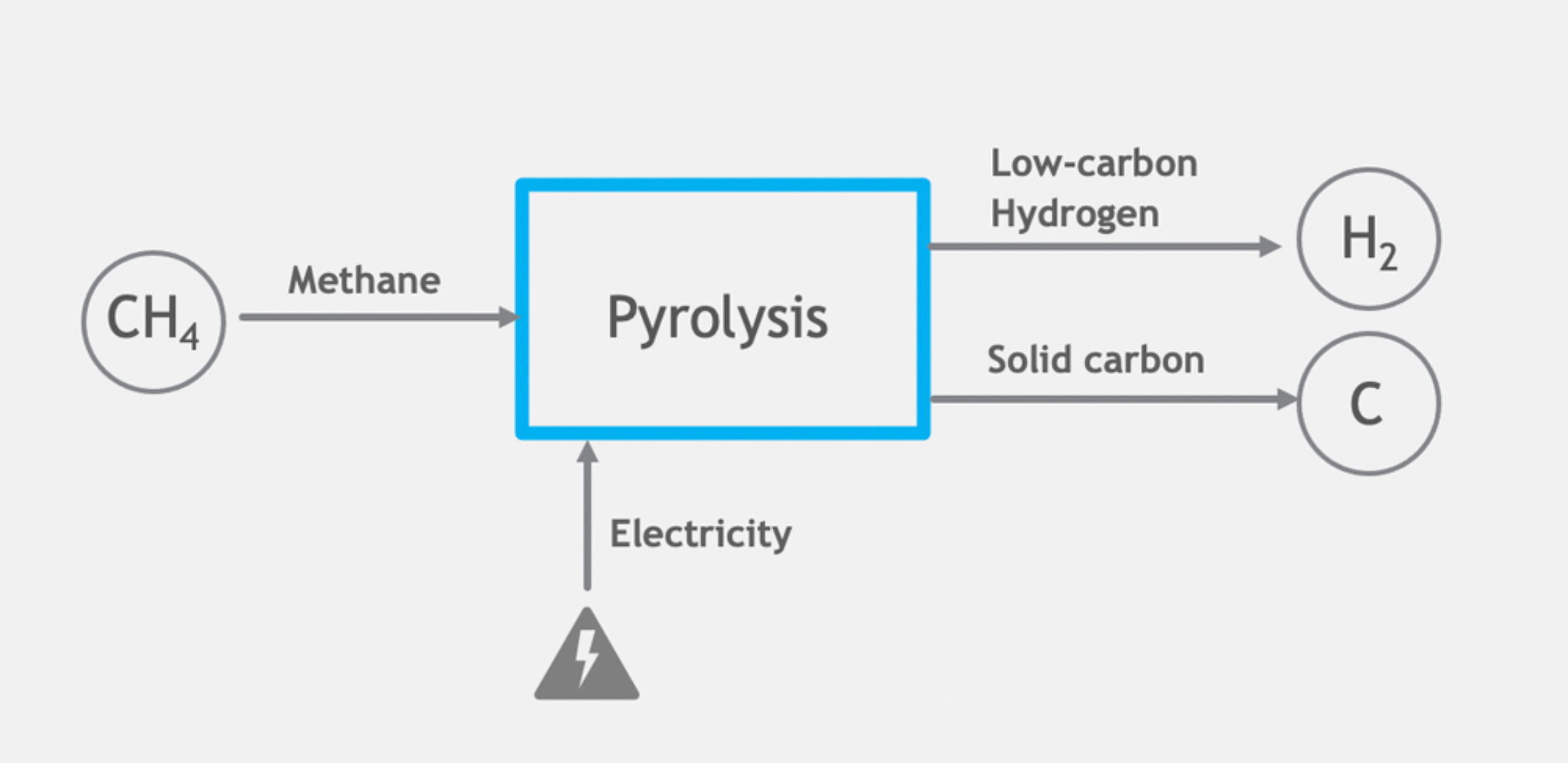
Figure 1. Simplified block diagram of the CH₄ pyrolysis process.
Types of CH₄ pyrolysis
CH₄ pyrolysis technology is available in three different types in the market: plasma, thermal and catalytic pyrolysis. Plasma pyrolysis is the most mature form and has two methods. The first uses plasma torches to provide heat, and the second uses plasma microwaves to directly ionize the CH₄ gas, creating plasma. In thermal (hot) pyrolysis, CH₄ is split into H₂ and carbon at temperatures above 1,200°C with no catalysts. The main downside of this non-catalytic process is the long cracking times below 1,000°C. In the catalytic pyrolysis process, CH₄ breaks down into H₂ and carbon over a metal catalyst between 600°C–900°C. Packed bed and fluidized bed reactors are typically considered for catalytic pyrolysis. All pyrolysis types achieve the same objective of producing H₂ from CH₄ but use different methods.
Carbon products based on the CH₄ pyrolysis approach
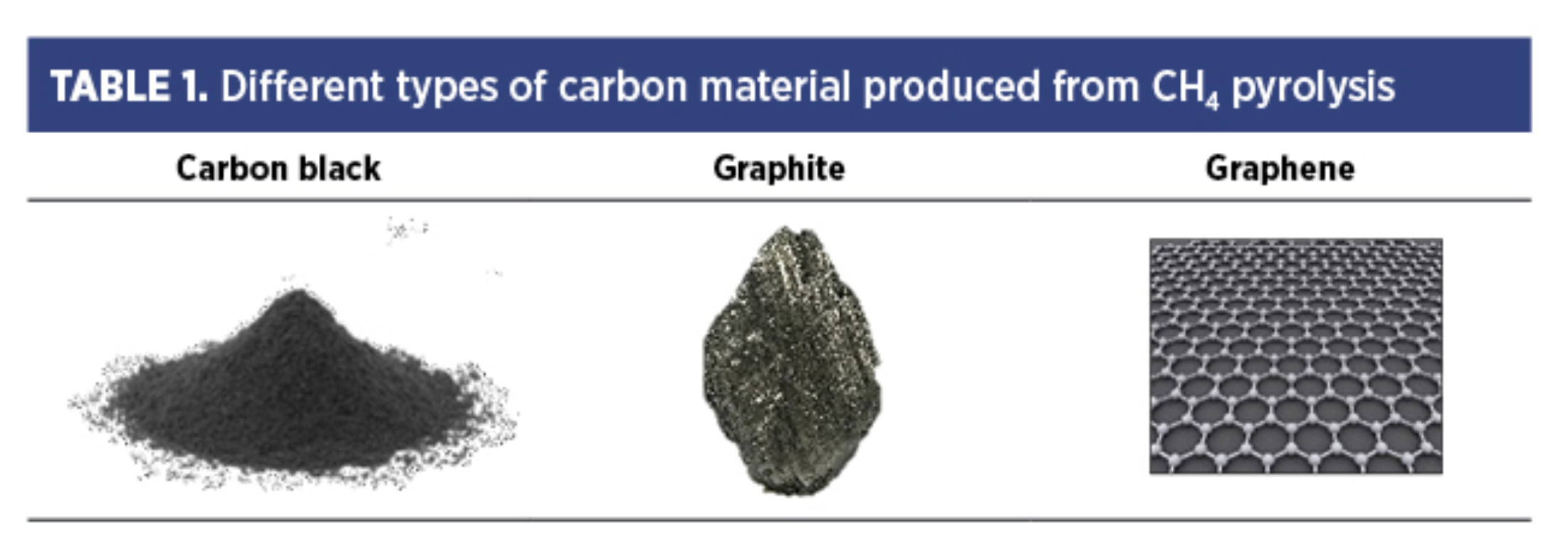
Various types of carbon material are produced from CH₄ pyrolysis, depending on the pyrolysis types and reactor temperature range. CH₄ pyrolysis produces solid carbon that can be sold to the market as graphite, graphene and carbon black, offsetting the H₂ production cost and preventing the carbon from being emitted as carbon dioxide (CO₂). Carbon black and graphite can be used in tires and batteries, while graphene can be used in batteries, electric/photonic circuits, concrete and various medical applications (TABLE 1).
Environmental impact
CH₄ pyrolysis offers a potentially significant environmental benefit by utilizing CH₄ , a potent greenhouse gas (GHG), as a feedstock to produce H₂ and solid carbon. The H₂ produced via CH₄ pyrolysis provides a cleaner alternative to conventional H₂ production methods [e.g., steam methane reforming (SMR)], which release CO₂ as a byproduct. CH₄ pyrolysis enables H₂ production without direct CO₂ emissions, contributing to decarbonization efforts.
SMR vs. CH₄ pyrolysis
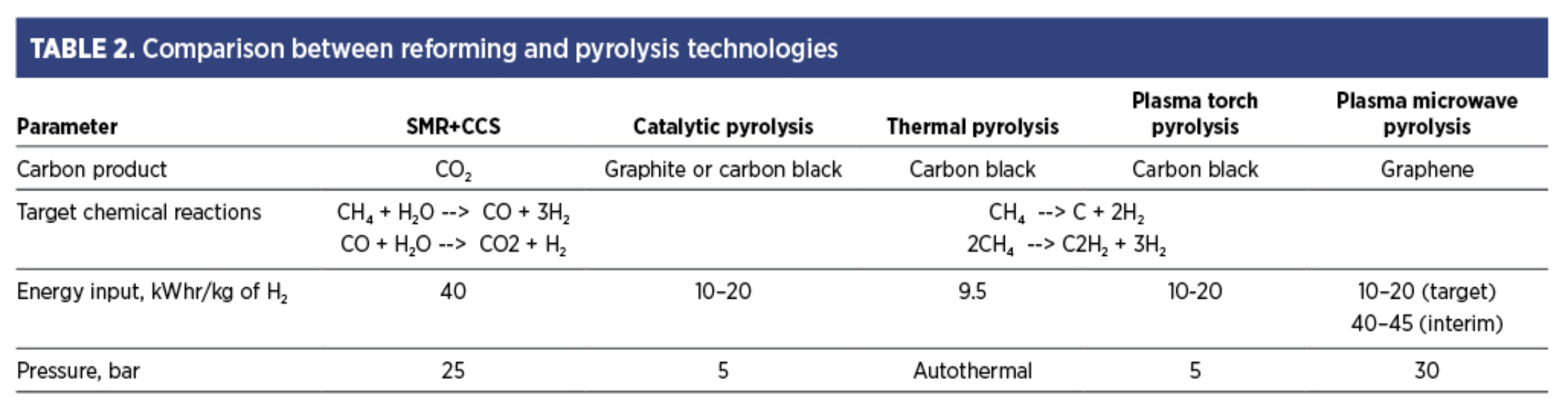
The differences between CH₄ reforming and CH₄ pyrolysis are shown in TABLE 2. Carbon is emitted from an SMR unit as CO₂ while in all types of pyrolysis, carbon is captured in a solid form (graphite, graphene and/or carbon black). Pyrolysis eliminates the need for carbon capture and storage (CCS) to produce CO₂-free H₂. In addition, CH₄ pyrolysis requires approximately half the energy required by the SMR process to produce the same amount of H₂ with lower H₂ pressure output. However, the energy input of SMR and CCS (SMR+CCS) becomes equivalent to the pyrolysis plasma microwave method if the H₂ is compressed to 30 bar as an output (TABLE 2). The energy input of SMR+CCS is similar to microwave plasma due to the additional energy costs of the compression. The energy cost ratio to compress CH₄ pyrolysis technology is 1 kWhr/kg of H₂.
Takeaway
As this field continues to evolve, improvements in efficiency and cost-effectiveness are expected, potentially making CH₄ pyrolysis a more viable and competitive option for H₂ production in the future, addressing climate change and the transition toward a low-carbon environment. However, it is worth noting that CH₄ pyrolysis is an evolving field of research and development, and further advancements are necessary to optimize the process efficiency, scalability and economic viability.